

A Vital Leadership Skill: How to Ask AI Questions to Tackle Complexity
Focusing on leadership development, I’ve often written about my admiration for Bob Tiede, author of Leading with Questions. His work resonates deeply with me—after all, in Millennials Matter, I referenced the power of questions 157 times. So when his latest newsletter landed in my inbox, it hit at the perfect moment.
I was staring at a big, tangled, “where on earth do I start?” kind of problem—exactly the kind of moment when we want help from AI but don’t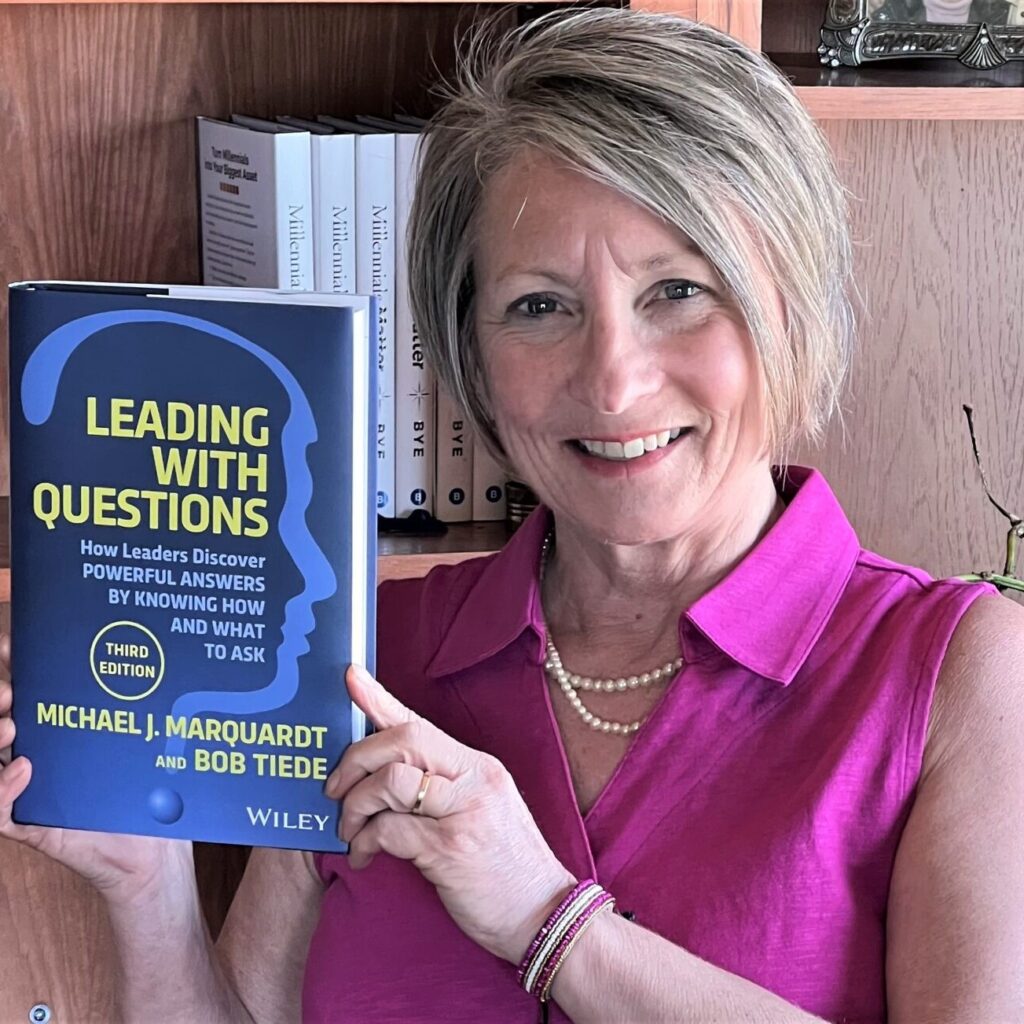 know the right question to ask.
Maybe you’ve been there too, when the pieces are all swirling and colliding in your mind.
If so, this article is for you. I hope that it helps you ask the kind of AI questions that pull you out of the mess and into clarity.
Danita
Get the Book Leading with Questions HERE.
Publication: Leading with Questions
Author: Bob Tiede
Date: December 1, 2025
Read the original article HERE

How to Ask AI Questions to Tackle Complexity
I’ve run many AI training and discovery sessions with executives over the past year. Every single one follows the same pattern.
Someone opens ChatGPT. Type “Should we expand into the Southwest?” Hit enter. Scans the generic response about market research and competitive dynamics. Closes the tab.
“Not helpful.”
They’re treating a sophisticated thinking tool like a Magic 8-Ball. Ask a yes/no question. Get a vague answer. Move on.
The problem isn’t the AI. It’s the question.
We’re Asking the Wrong Questions
Most executives approach AI the same way they approach Google: Type in a question. Get an answer. Done.
But that’s not what these tools are built for. Large language models like ChatGPT, Claude, and others aren’t search engines. They’re thinking partners. The difference matters.
When you Google “Southwest market expansion,” you get facts: population data, competitor lists, and economic indicators. Useful, but you still have to figure out what those facts mean for your specific situation.
When you ask AI the right kind of question, you get frameworks. Perspective. Strategic thinking. Not just generic advice. You get actual help thinking through your unique problem.
But only if you ask questions that invite that kind of thinking from you as a human. This is what I call human-centered AI.
From Closed to Open: A Simple Shift
Here’s the shift: Stop asking closed-ended questions that beg for yes/no answers. Start asking open-ended questions that force deeper thinking.
Instead of: “Should we implement remote work?”
Try: “Give me three different strategic approaches a 200-person company could take to remote work. For each approach, show me what would have to be true for it to work, the cultural implications, and the business model impact.”
See the difference? The first question gets you a coin flip. The second gets you a framework for actually thinking through the decision. As a human now, you can review the answers and find the best parts of the scenarios the AI has presented. Three is a magic number that humans like reviewing, by the way.
Or instead of: “Is AI right for my business?”
Try: “Lay out three distinct timelines for implementing AI in a professional services firm: cautious, aggressive, and selective. For each timeline, what are the resource requirements, likely outcomes, and biggest risks?”
You’re not asking AI to make your decision. You’re asking AI to help you see your decision from multiple angles.
Breaking Down Complexity with Strategic Questions
Last month, I worked with an executive struggling with a pricing decision. He’d been mulling it over for weeks. In our session, instead of asking “Should we raise prices?” I showed him how to ask:
“Here’s our current pricing model and our customer segments. Give me three different pricing strategies we could pursue: premium positioning, volume-based, and value-tiered. For each strategy, walk me through the revenue implications, customer response risks, and competitive dynamics.”
In five minutes, we had a framework that showed him exactly what each path would require. More importantly, he could see that his real question wasn’t about raising prices—it was about which customer segments he wanted to serve. Claude is now smart enough to even build these models for you in native Excel.
That’s what I mean by asking questions that tackle complexity instead of avoiding it.
The Iterative Conversation
Here’s what most executives miss: AI conversations aren’t one-and-done.
You get that first strategic framework. Then you dig deeper.
“For the premium positioning strategy, what would be the first three implementation steps? What metrics would tell us if it’s working? Where would we hit roadblocks?”
Then: “You mentioned customer churn risk. How would I test for that before fully committing to this strategy?”
Each answer leads to the next question. You’re not looking for THE answer on the first try. You’re using AI to think through your problem systematically, refining your understanding with each exchange.
I’ve had day-long conversations with AI that completely reshape how I understand a business challenge. Not because AI gave me the answer, but because the questions forced clearer and clearer thinking.
Seeing Around Corners
One of the most powerful questions you can ask AI: “What am I missing?”
“I’m considering these three strategic directions. What are two or three factors I probably haven’t considered? What blind spots might I have?”
Or: “Here’s my thinking on this decision. What’s the strongest argument against this approach?”
When I started Strategy for AI, I used this on a market entry decision. I laid out my logic and asked what I was overlooking. The response surfaced two customer segments I’d overemphasized and one competitive dynamic I hadn’t fully considered.
Did AI know my business better than me? No. But it forced me to think more comprehensively than I would have on my own.
Role-Playing Difficult Conversations
Here’s an unexpected use: practicing hard conversations.
Before a tough discussion with your leadership team, try: “I need to present a controversial strategy change. My CFO will push back on cost. My COO will worry about operational complexity. Help me anticipate their objections and prepare responses.”
Or: “Role-play this conversation with me. You be the skeptical board member. Don’t tell me my answers are good until I have proved it.”
It’s like having a sparring partner who helps you refine not just what you’ll say, but how you’ll respond when things go sideways.
The Fundamental Shift
 Stop asking AI for answers. Start asking AI to help you think.
Not: “What should our strategy be?”
But: “Walk me through three key questions I should answer before defining our strategy.”
Not: “Is this a good idea?”
But: “What would have to be true for this to be a good idea? What would have to be true for it to be a bad idea?”
Not: “How do I solve this problem?”
But: “Give me three completely different ways to think about this problem.”
This isn’t about making AI do your thinking. It’s about using AI as a tool to think more rigorously, from more perspectives, with fewer blind spots.
The Bottom Line
Complexity doesn’t vanish just because we simplify our questions. And yes/no answers rarely capture the depth of tough decisions.
AI won’t replace your judgment. But if you learn to ask strategic, iterative, and perspective-expanding questions, it can transform how you approach complexity.
That executive who typed “Should we expand into the Southwest?” and closed the tab? Two weeks after our training, he called back:
“I spent 30 minutes with ChatGPT working through that question. I asked it to show me three different timing scenarios, the risks of each, and what indicators would signal the right path. We’re not expanding now, but I know exactly why, and what would have to change for me to reconsider.”
That wasn’t AI making the decision. It was AI helping him ask better questions until he found the answer himself.
That’s the power of learning to ask the right kind of AI questions.

Let’s discuss a tailor-made interview to meet your audience’s needs.
Virtual speaking event? No problem!
Check out my Speaker page HERE.
To schedule a call, contact me at danita@danitabye.com
No Comments