

Leadership Character in the Age of AI
Introduction to the Character Matters Series
The moment that stays with me
Across from me sits a young mo
Even the one-year-old never li
At first, I feel relief. No no
A
Questions begin racing through my mind. Who is shaping these
The moment stays with me, not because it is extreme, but bec
We often assume the greatest f
The truth may be far more unco
When leaders fail to intention
Why Character Matters in the A
 We are living through a historic turning point. Machines now
Artificial intellige
From where I sit today, as a higher education board member,
What kind of leaders will emer
How might we lead wisely by sh
- Critical thinking.
- Discernment.
- Emotional intelligence.
- Moral judgment.
- Lifelong learning.
Artificial intelligence may ou
It cannot supply wisdom or determine what is right. Th
Which is why character is no l
Building the Courageous Core
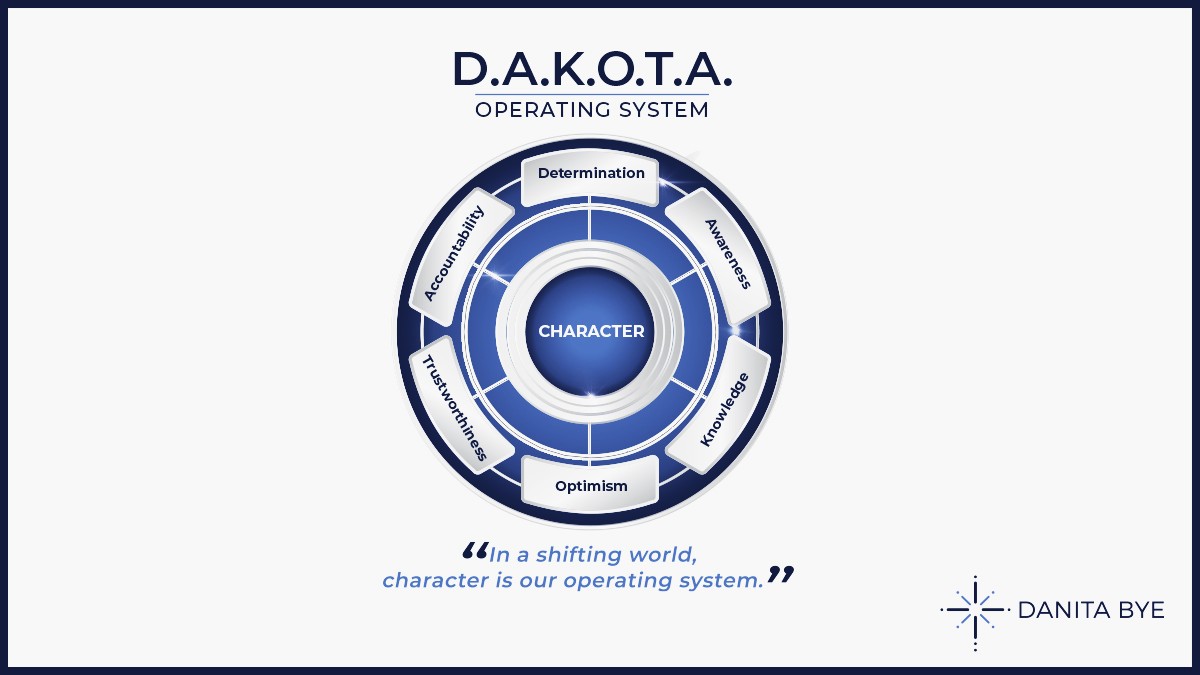
This conviction led me to deve
At its core, D.A.K.O.T.A. help
So how do leaders build that k
This series includes excerpts
Technology can enhance capabil
Character is the leadership ad
Millennials Matter: Proven Strategies for Building Your Next Gen Leader
Chapter 2: Courageous Leadership – Cultivate a Courageous Core (Updated excerpt from Millennials Matter)
“Courage is contagious. When a brave man takes a stand, the spines of others are often stiffened.” ~ Billy Graham 
A Courageous Core is crucial for strong character. It gives you a solid base to make a positive impact. Growing up, key people shaped my character and leadership skills. I owe a lot to many people. My parents, my church youth leader, and my piano teacher helped me grow. My first boss at Dairy Queen taught me responsibility. The president of the University of Sioux Falls guided my education. Finally, my first manager at Xerox showed me the value of hard work. They taught me that inner integrity matters more than outward image. Their influence still grows today. This is the essence of wise, lasting leadership.
The Character and Courage Leadership Framework
Our survey shows that 45% of CEOs and business leaders worry about character in new leaders. This is where we must focus. Everything we do comes from our core character.
Building our character is as vital as strengthening our physical core. A strong physical core improves balance and stability. It allows us to act freely. A strong character core supports all our actions.
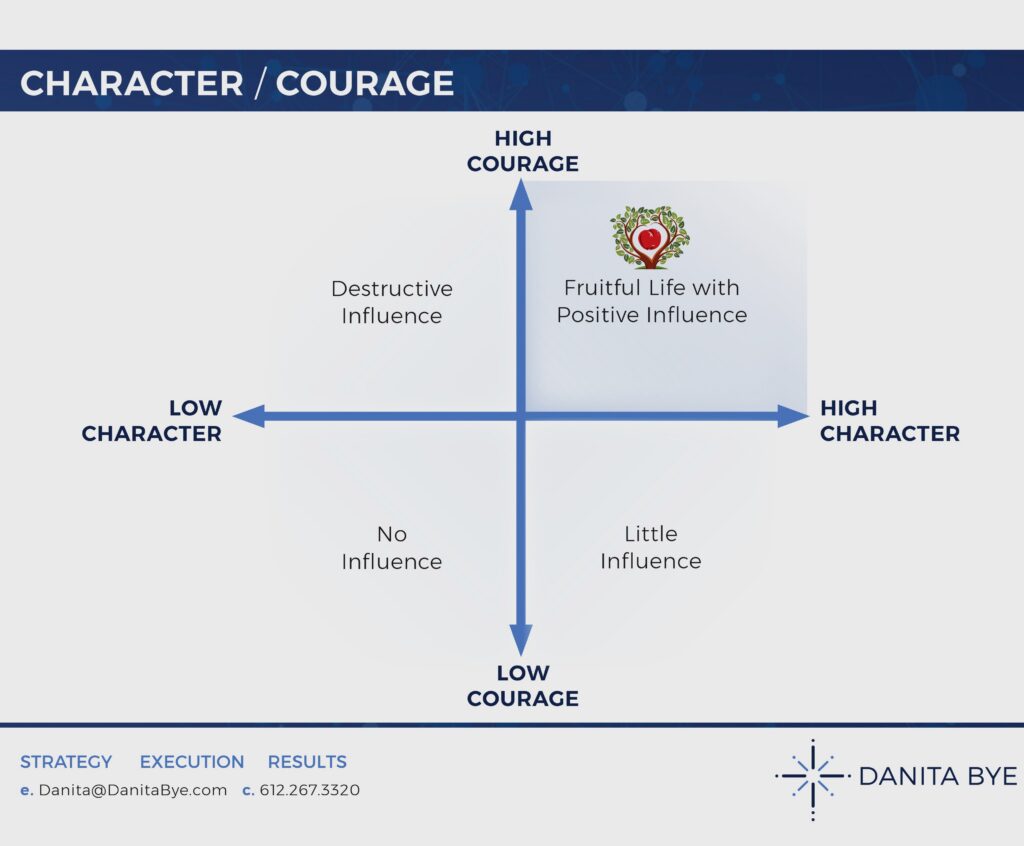 (Upper right quadrant of the 2 X 2) Leaders with both character and courage positively influence others. They take responsible risks and communicate openly with their teams.
Unfortunately, not all leaders have both.
(Upper left quadrant of the 2 X 2) Another group may be courageous and face challenges head-on. But if they lack character, their motives become suspect. Trust erodes. They may achieve short-term results, but they damage relationships and harm the company’s reputation. They have a destructive influence.
(Lower right quadrant of the 2 X 2) These leaders have high character, but not courage. They have little influence, avoid challenges, and fail to earn respect.
(Lower left quadrant of the 2 X 2) These leaders have low character and low courage.
A next-gen leader’s character core shapes how they manage relationships and tackle new responsibilities. Ultimately, this affects their ability to succeed…
Why Is Cultivating a Character Core Important for your next-gen leader?
When I talk about character development with young leaders, I hear various responses:
- “Isn’t character a given? It feels pointless to discuss.”
- “Isn’t it insulting to bring up character with young leaders? They’ve graduated.”
- “I don’t see character as a problem. They have issues like entitlement and short-term thinking, but not character.”
I shared these thoughts with Phyllis Hennecy Hendry, CEO of Lead Like Jesus. She quickly replied, “Many business failures stem from character flaws, not just mistakes.”
She added, “I heard from a church staff member: ‘Who our church becomes tomorrow is who our staff becomes today.’ This applies to any business. If we don’t develop character in our staff, our future looks bleak.”
In the past, character development began early. I admire the grit of those who settled in North Dakota. Their inner strength helped them endure harsh weather.
This question ties to the ancient wisdom of the Cardinal Virtues, which came from Aristotle:
- Prudence,
- Justice,
- Temperance, and
- Courage.
The Church also values three core Theological Virtues:
- Faith,
- Hope, and
- Charity/Love.
While virtue may seem outdated, it’s time to revive it! We must integrate virtues into our companies. Many avoid this topic because it’s hard to discuss and measure.
 Growing up on the TTT Ranch in North Dakota, I connect with the Code of the West. Here are ten principles from The Center for Cowboy Ethics and Leadership:
- Live each day with courage.
- Take pride in your work.
- Always finish what you start.
- Do what needs to be done.
- Be tough but fair.
- Keep your promises.
- Ride for your brand.
- Talk less, say more.
- Remember, some things aren’t for sale.
- Know where to draw the line.
This sense of right and wrong has been instilled in many across America, no matter their background. We learned that character strength comes from within.
However, recent leadership theories focus more on appearances and traits. They often overlook the leader’s deep moral character. It’s as if this topic is ignored.
Yet Doug Lennick and Fred Kiel, in their book Moral Intelligence, found that strong moral skills are key to successful leadership and a business edge. The most trustworthy leaders have strong moral beliefs and act on them. Even in a world that sometimes rewards bad behavior, the best way to build a successful business is to hire those with high moral and ethical skills.
This focus on character aligns with ancient wisdom that has shaped leaders for centuries.
So, how do we translate these ancient virtues into modern ideas our mentees can grasp? How can you help your next-gen leader understand these concepts for everyday use?
I use the D.A.K.O.T.A. operating system as a tool to describe this translation process. Based on my North Dakota roots, I hope it guides you as you work with Millennial leaders, and all up-and-coming leaders, from grandchildren to VPs, to build a strong, courageous core.
Determination
Awareness
Knowing
Trustworthiness
Accountability
Here’s how I see the connections between the classical 7 cardinal virtues and the actionable DAKOTA operating system Character traits:
- D – Determination (Fortitude)
- Staying steady when change feels overwhelming.
- Fortitude is courage and perseverance in the face of adversity. Determination embodies this by pushing through challenges, staying resilient, and showing grit—essential qualities for leaders navigating the AI revolution.
- A – Awareness (Prudence)
- Seeing clearly amid noise and distraction.
- Prudence is wisdom in action—making thoughtful, well-informed decisions. Awareness aligns perfectly, as leaders must develop keen situational awareness, emotional intelligence, and discernment in an era of rapid technological change.
- K – Knowledge (Justice)
- Pursuing truth beyond data and trends.
- Justice is fairness, integrity, and doing what is right. Knowledge supports this by ensuring leaders are informed, educated, and capable of making ethical decisions that promote fairness in their organizations and communities. Pursuing truth beyond data and trends.
- O – Optimism (Hope)
- Choosing possibility over panic.
- Hope is the virtue that keeps us striving toward a better future. Optimism fuels this by maintaining a positive vision, inspiring others, and fostering a mindset that embraces innovation and opportunity rather than fear.
- T – Trustworthiness (Faith)
- Building confidence through consistency and care.
- Faith is belief, trust, and conviction. Trustworthiness reflects this by demonstrating reliability, honesty, and a deep commitment to ethical leadership—building trust with teams, clients, and communities.
- A – Accountability (Temperance)
- Owning outcomes and influence.
- Temperance is self-control and balance. Accountability brings this to life by holding oneself and others responsible, ensuring discipline, and maintaining integrity in decision-making and leadership.
That leaves Love, which is the greatest of all virtues. I see it as the foundation that ties everything together—serving others, leading with empathy, and acting with purpose. While it’s not explicitly in the acronym, it could be woven throughout the framework as the driving force behind great leadership.
Summary: Character Endures When Everything Else Shifts
As leaders, we often assume the greatest risks of the AI revolution are technical: flawed models, biased data, or systems that move faster than our policies can keep up.
The moment that stays with me does not come from a strategy session or a briefing. It comes from a doctor’s waiting room. Five small children sit quietly across from me with their eyes fixed on glowing screens. There is no noise, no resistance, and no disruption. At first glance, the scene resembles calm.
The calmness is a facade. Their values and character are being shaped by an AI algorithm. Identity is being influenced long before those children can question who, or what, is influencing them.
This reality represents a leadership challenge of the AI age.
When character is weak or underdeveloped, power, whether human or artificial, never remains neutral. Power simply amplifies whatever values are already present. When leaders fail to exercise discernment, cultivate awareness, and intentionally shape what matters most, another influence will take that role quietly, efficiently, and by default.
Character is no longer a soft value or a secondary leadership trait. Character is the strategic center of leadership in an accelerated world.
If leaders do not shape character intentionally, character will still be shaped. The difference is that the shaping will not come from them.
That is why, now more than ever, character matters.
Character is the leadership advantage AI cannot replace.
Leadership Lesson:
Cultivate a courageous character core. It provides the foundation leaders need to guide change rather than simply react to it.
Leadership Question:
Where do you need to demonstrate courageous character so that you lead AI rather than allowing AI to lead you?
© Danita Bye – Worked with AI for clarity and Hemingway for readability.

Let’s discuss a tailor-made interview to meet your audience’s needs.
Virtual speaking event? No problem!
Check out my Speaker page HERE.
To schedule a call, contact me at danita@danitabye.com
No Comments