


The Price of Mass Amusement (After Babel Substack)
Of all the leadership development discussion questions we asked, this sparked the most conversation. The first answer from many of the students was yes. Then, those who thought ‘not’ immediately spoke up, talking about the difference between knowledge and wisdom.
We talked about the benefits of AI as a tool and the hazards of AI becoming a crunch. We discussed how both AI and social media form us as leaders, versus us, as leaders, choosing to do the hard work of developing character.
It’s on the way home from Tanzania that I read this intriguing article by Andrew Trousdale, Beyond Babel substack, analyzing Neil Postman’s work, Amusing Ourselves to Death: Public Discourse in the Age of Show Business, that deals with this topic.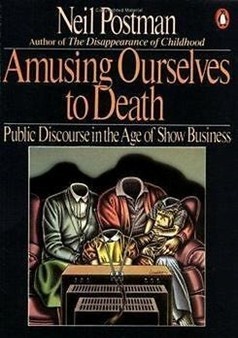
Quotes
Quote 1: In Amusing Ourselves to Death, Postman argues that television damaged American culture in two major ways: first, it undermined public discourse with a flood of fragmented and irrelevant information; and second, it demoralized us by turning amusement into a virtue.
Quote 2: What Orwell feared was those who would ban books.
What Huxley feared was that there would be no reason to ban a book, for there would be no one who wanted to read one.
Orwell feared those who would deprive us of information.
Huxley feared those who would give us so much that we would be reduced to passivity and egoism.
Orwell feared that the truth would be concealed from us.
Huxley feared the truth would be drowned in a sea of irrelevance…
In 1984, Orwell added, people are controlled by inflicting pain.
In Brave New World, they are controlled by inflicting pleasure.
In short, Orwell feared that what we fear will ruin us.
Huxley feared that what we desire will ruin us. (p. xxi-xxii)
Quote 3:These changes in form were therefore essential for Postman. Though he cared about how people use technology, he was especially concerned with how technology changes the people who use it. Elsewhere, he said: “a new technology does not add or subtract something. It changes everything.” (p. 18)1
Quote 4: Americans no longer talk to each other; they entertain each other. They do not exchange ideas; they exchange images. They do not argue with propositions; they argue with good looks, celebrities, and commercials. (Pg. 92, Amusing Ourselves to Death)
Quote 5: By flooding us with attention-grabbing content condensed for rapid consumption, electronic media turned information into a stimulant.
 Quote 6: The second fundamental difference is algorithms. TV draws us in and shapes us. But compared to algorithmic media, it is generic. Algorithms morph content to us, drawing us in and changing us more thoroughly. The promise of personalization is seductive, but the cost is steep. By accommodating our preferences and prejudices, algorithms distort reality and distance us from each other. In doing so, they make us fragile and righteous. They drain our interest in the world. And in the end, the personalized amusement is only a means of capturing our attention: the more we consume from algorithms, the more they consume us.
Quote 7: Americans are the best entertained and quite likely the least well-informed people in the Western world.
Quote 8: The second great tradeoff is in the title: Amusing Ourselves to Death. The price of amusement, pursued with evermore technological efficiency, is death—whether spiritual or cultural.
Read the article HERE: The Price of Mass Amusement
Publication: After Babel, Substack
Author: Andrew Trousdale
You may also enjoy this article, where I refer to Neil Postman’s book: How to Transform Trust into Leadership Currency in the AI Revolution

Let’s discuss a tailor-made interview to meet your audience’s needs.
Virtual speaking event? No problem!
Check out my Speaker page HERE.
To schedule a call, contact me at danita@danitabye.com
No Comments