

Optimism: An Activating Force that Fuels Leaders in the Age of AI (Character Matters Series)
While we’re all trying to come to grips with the AI Revolution, a friend of mine and president of Crash-Sues, Heidi Habben, recently asked a question you may be quietly thinking but rarely saying out loud: “Just because we can automate something, does it mean we should?”
Heidi is not anti-technology. She has spent her career on the leading edge of innovation. Yet, as artificial intelligence accelerates, she raises thoughtful questions about what automation means for human judgment, responsibility, and the systems we rely on every day.
Her questions are not alarmist. They are discerning between technology and moral responsibility. Her questions are similar to those of Pope Leo – Pope Leo calls for ‘robust’ regulation in a sweeping manifesto.
On one hand, you are watching rapid promises of automation, health care breakthroughs, and entirely new job categories. Many of those promises may come true.
At the same time, your news feed delivers a steady stream of war, crime, disruption, and cultural tension. Neuroscientists remind us that your brain is wired to detect threats first. That instinct protects you, but it can also train you to expect the worst about the future.
In seasons of leadership dilemma, you face a choice. You can drift toward cynicism and fear. Or, you can cultivate something stronger.
This brings us to optimism.
Optimism is not naïve positivity. It looks reality in the eye and still believes better outcomes are possible. It steadies you, fuels courage, and activates forward movement when others begin to stall.
I learned what realistic optimism looks like long before AI was a headline. It started with a tractor and a quicksand spot on our ranch.
Updated and expanded excerpt from Millennials Matter, Chapter 6
Optimism: An Activating Force That Fuels Leaders
“Dad, what was the worst stuck tractor you ever had to deal with?” I asked during an after-dinner conversation while at The Triple T Ranch.
He immediately knew. No hesitation.
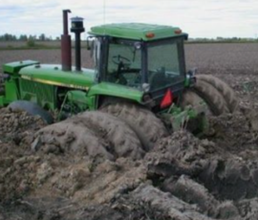 It was December of 1979, and he’d just invested in a brand-new John Deere tractor. It was beautiful, shiny, and equipped with all the latest gadgets. In our pasture right behind the barn, there is a protected area that’s great for feeding cattle, except in one place—the quicksand spot. It’s roughly forty feet in diameter. A crowbar thrown in the middle will disappear in a short time. In summer, you can avoid it because you can see it. In winter, it freezes hard enough that you can drive over it, making it easier to feed the cattle.
That December, the temperature crept above freezing and remained there for a few days. On a Sunday morning, Dad climbed into his shiny new tractor to quickly feed the cattle before heading into town for church. In short order, hay filled most of the troughs. It looked like he’d get to church on time. He maneuvered the tractor to pick up the last load, then shifted gears to drive the tractor forward. Nothing happened. Dad glanced back. What he saw was the back end of the tractor sinking into the quicksand … all the way to the top of the back tires.
What do you do when the back end of your new John Deere is completely submerged in a thawing sinkhole?
Many would have given up on that tractor. That’s the unforgiving nature of quicksand. Not my dad. He remained optimistic that there had to be a solution for getting his brand-new tractor back to work. He quickly dove into problem-solving mode.
The tractor had stopped sinking, so for days after, he searched and eventually found a man experienced in dragging oil tankers and semitrucks out of precarious situations. It was expensive, but Dad’s optimism prevailed, and he saved the tractor.
What lesson did I learn from him? That being stuck, literally or figuratively, is no match for one’s mental strength and external resources. His attitude toward adversity was one of realistic optimism. He had a hopefulness and confidence that got him through many difficult situations.
Optimism is a confident belief or mindset that expects good outcomes even in tough circumstances. It requires active virtues of faith, hope, temperance, and prudence.
Who exemplified realistic optimism for you during your growing-up years?
How to Nurture Optimism in Your Young Leader
High morale is usually tied to increased creativity, critical thinking, decision-making, and productivity. This is not a rose-tinted-glasses brand of optimism. “Don’t worry, be happy” doesn’t quite cut it. A true optimist is aware of the issues at hand and yet makes a deliberate choice to stay positive.
Be willing to share some tips and strategies from your personal experience that have helped you overcome daunting discouragements. Here are some of the optimistic insights I’ve learned.
See Humor in Life
 I love what the ancient sage Solomon says, “A cheerful heart is good medicine, but a broken spirit saps a person’s strength” (Proverbs 17:22 NLT). Show your own ability to find humor, even in the midst of a tense and difficult situation. Teach your young leader how humor breaks the tension in stressful situations and, if used correctly, builds their leadership quotient.
Cultivate Gratitude
When your next-gen leader is stuck, either literally or figuratively, it’s easy to focus on what’s disheartening and discouraging. Everything seems to have a gray hue. However, the attitude of being grateful is completely separate from our circumstance.
One can change one’s entire life by cultivating a grateful outlook. That may sound a bit dramatic, but recent brain chemistry research, which David D. Burns discusses in Feeling Good: The New Mood Therapy, confirms that the more exercise you give your brain in being grateful, the more you can defeat hopelessness and be more spontaneously grateful in the future. Gratefulness turns on the light switch, shedding light on possible solutions.
So how do you cultivate gratefulness? Here are a few ideas to share with your mentee:
-
- Encourage them to carry a gratitude journal, and commit to recording at least three things in the
 journal throughout the day.
 - If there’s someone your young leader isn’t getting along with, urge them to write three to five positive attributes they notice in that person during the day. Depending on how cantankerous the relationship is, this may take a long time to do, but the payoff of rewiring their brain is worth it.
- Have them record ten items or situations they’re grateful for at the end of each day. They’ll get uplifting food-for-thought in their brain before falling asleep.
- Encourage them to carry a gratitude journal, and commit to recording at least three things in the
 journal throughout the day.
Focus on the Truth
Does your young leader know the acronym FEAR—False Evidence Appearing Real? In today’s world, it can be easy to get all worked up by “fake news,” whether it pertains to politics, angst from prospects or clients, or talk at the water cooler. Discuss with your mentee the times you learned the hard way to focus on the truth. You’ll build optimism as well as perspective. Dwell on the known facts. If you want to know what’s in the future, you have to start by focusing on today’s facts.
Hang with the Right Crowd
Remind your mentee to surround himself or herself with optimistic people at work who energize others, and to limit  their time with pessimistic, draining people. This will stimulate creativity and increase job satisfaction. Feel free to share a time when you learned this the hard way. Also, strive to model it now that you’re more seasoned.
Ask for help
Remind your young leader to reach out for help. The conditions we face are often beyond the scope of our abilities, but not beyond the scope of our community or our Creator, God.”
Leadership Reflection
At the beginning of this article, you encountered a simple but weighty question from my friend Heidi Habben – Just because we can automate something, does it mean we should?
Where are you on the AI adoption curve? What benefits do you see? What quiet concerns are you carrying?
Artificial intelligence can forecast trends, optimize systems, and process enormous amounts of data. It can accelerate outcomes and increase efficiency. Yet, it cannot determine the leadership presence you bring to your responsibilities of casting vision, forming strategy, aligning resources, and motivating people.
AI forecasts outcomes. You decide whether to lead with fear or with hopeful realism.
In uncertain seasons, that decision shapes more than any algorithm ever will.
Virtue and Vice – The Leadership Posture Toward the Future
The real battle before you is not technological. It is internal.
Virtue shows up as hope-filled optimism. Optimistic leaders engage challenges rather than retreating from them. They adapt when conditions shift. They look at constraints and ask a different question: What might be possible? Optimism does not ignore reality. It confronts reality while moving forward with disciplined hope.
Optimism has competitors.
- Cynicism hardens the heart. It stops working, because “nothing really changes.”
- Fear-based realism sounds practical but quietly lowers expectations. Vision shrinks under the banner of prudence.
- Quiet resignation whispers, “It is what it is.” With that phrase, courage quietly erodes.
These responses feel reasonable in challenging times. Over time, however, they drain energy, creativity, and leadership capacity.
Leadership Lessons from the Tractor
Think back to the tractor sinking into quicksand.
The situation was real. The cost was real. The frustration was real. Surrender was not the only option.
Your leadership environment may feel similar. The ground shifts, technology accelerates, and cultural pressure builds. Giving up on hopeful problem-solving remains a choice.
When I wrote Millennials Matter, I emphasized that young leaders are watching more than results. They are watching how you are leading through technological upheaval, when conditions become uncertain. They are learning from your posture toward the future.
Optimism is not naïveté. It is emotional steadiness under pressure. It is intellectual flexibility that searches for solutions instead of rehearsing defeat. It is courage anchored in truth.
Summary
Optimism fuels forward movement when hope is grounded in character and disciplined realism.
The future will always carry uncertainty. Leaders who cultivate realistic optimism help others move forward when fear, cynicism, or resignation threaten to stall progress. Heidi’s question remains relevant: “Just because we can automate something, does it mean we should?”
Optimism does not deny difficulty. It refuses to surrender the possibility.
Leadership Lesson: Optimism is hope grounded in character and disciplined realism.
Leadership Question: Where are you tempted to be cynical? How might hopeful realism fuel your leadership influence?
© Danita Bye. Developed with AI assistance to enhance clarity and flow. Worked with Hemingway for readability.

Let’s discuss a tailor-made interview to meet your audience’s needs.
Virtual speaking event? No problem!
Check out my Speaker page HERE.
To schedule, a call contact me at danita@danitabye.com
No Comments